There was a time (not long ago) when HR was seen as an administration department (essential, yes, but largely reactive). Payroll processed, contracts issued, policies enforced. Job done. But that version of HR? It doesn’t quite cut it anymore.
So, what changed?
Business complexity. Talent scarcity. You know the deal. Add to that the pace of cultural/digital transformation, supporting employees, and the increasing regulatory pressure…most teams are operating at full capacity
And suddenly, people strategy isn’t a support function. It’s pure strategy.
HR has stepped into a far more influential role, moving from operational player to strategic partner. Today, HR sits alongside the C-suite — right where decisions about growth, culture, and long-term resilience are made.
In many organisations, HR is no longer reporting into the business — it’s helping to steer it.
But here’s the uncomfortable truth: proximity doesn’t equal impact.
Just having a seat at the table isn’t the same as having a voice that’s listened to.
Let´s dive into what influence in HR really is and how to achieve it.
What influence in HR really means
HR influence isn’t about power.
It’s not about hierarchy, job titles, or simply sitting next to the CEO in leadership meetings. Proximity to decision-makers might look like influence, but on its own, it doesn’t deliver it.
So, what does HR influence REALLY mean?
It’s the ability to shape outcomes that matters. Not just to contribute to conversations, but to actively influence decisions. Decisions that affect budgets, priorities, and ultimately, people’s day-to-day experience at work.
Because being “close to the business” is one thing. Having an impact on where investment goes? That’s something else entirely.
The pillars of HR influence
What does real HR influence look like in practice? It’s not about louder voices or bigger job titles. It’s built on a set of capabilities that quietly (but powerfully) shape how HR shows up in the business.
Get these right, and HR becomes indispensable. Miss them, and you risk being seen as supportive… but not strategic.
The facilitator: enabling managers and employees to perform
At its core, influential HR acts as a facilitator — not a gatekeeper.
That means shifting away from “owning” every decision and instead empowering managers to lead effectively. Are your managers confident in handling performance conversations? Do employees feel supported when it matters?
HR’s role here is to remove friction, provide clarity, and create frameworks that make good decision-making easier across the organisation.
It’s less about control, more about enablement. And for many HR teams, that’s a mindset shift that feels like giving up power — when in reality, it’s how you scale it.
A business mindset: speaking the language of growth
If HR wants influence, it needs credibility. And credibility comes from understanding the business beyond the org chart and roles.
What drives revenue? Where are the cost pressures? Which roles are truly business-critical, and which are simply “nice to have”?
An HR leader with a business mindset doesn’t just ask, “How many people do we need?” They ask, “What capabilities will unlock growth — and how quickly can we build or buy them?”
This is where HR stops being a service function and starts acting as a strategic advisor. The kind that finance directors actually want in the room — because the conversation isn’t about policies, it’s about performance.
A data mindset: moving from instinct to insight
Gut feel has its place. But influence at c level? That’s driven by evidence.
A strong data mindset allows HR to move from retrospective reporting to forward-looking insight. Not just what happened, but what’s likely to happen next — and what the business should do about it.
Are you tracking the right metrics, or just the easiest ones? Can you link engagement to productivity, or turnover to cost? Are your insights actionable, or just interesting?
When HR uses data effectively, conversations change. Suddenly, you’re not “raising concerns” — you’re presenting risks, opportunities, and scenarios. That’s a very different (and far more powerful) position to be in.
How to build influence in HR
Influence in HR isn’t something you’re handed with a job title. It’s built in the moments that feel the least comfortable.
So, how do you actually strengthen it? Let me explain…
Strengthen the soft skills that really matter
Let’s start with the obvious (but often underestimated) foundation: human skills.
Empathy isn’t just a “nice to have”. It’s how you uncover what’s really going on beneath the surface. When a manager says performance is slipping, what’s the real issue? Capability? Motivation? Leadership? Without empathy, you’re only guessing.
Active listening plays a similar role. Are you truly hearing what’s being said — or just waiting for your turn to respond? The difference is subtle, but it’s where trust is built (or quietly lost).
In short, the better you understand people’s real challenges, the more precisely you can align HR actions with business outcomes. That’s influence.
Embrace AI and HR tech (or you´ll risk getting stuck)
Let’s be honest: if your HR team is still buried in manual processes, influence becomes an uphill battle.
Administrative overload is more than an problem, it’s a REAL strategic blocker. Time spent chasing spreadsheets or fixing payroll errors is time not spent partnering with the business and talking with the managers
This is where AI and modern HR tech come in. Automation, integrated modules, real-time data. Let´s be honest: all of it frees up time, and it should be reinvested where it counts:
understanding people, advising leaders, shaping strategy.
If you’re not actively leveraging HR tech to improve efficiency, you’re effectively choosing to stay in the back office, even if your title says otherwise.
Be willing to challenge leaders
This is where influence gets real.
It’s one thing to support leaders. It’s another to challenge them (constructively, confidently, and, obviously, with evidence).
Because on many many occasions, the business needs perspective.
So, are you willing to question a hiring push that doesn’t align with long-term strategy? To push back on decisions that could damage culture or retention? To bring data that contradicts instinct?
Of course, this isn’t a simple confrontation. It’s about adding value where it matters most (even when it’s uncomfortable). The HR leaders who build the most trust are often the ones who don’t just say “yes”.
Example of how HR influences the business
It’s easy to talk about “influence” in abstract terms. But what does it actually look like on the ground — in the day-to-day reality of a business?
Let’s bring it to life.
Turning data into clarity
A mid-sized organisation starts to notice a steady increase in voluntary turnover. Nothing dramatic — but enough to raise eyebrows. Leadership assumes it’s a pay issue. Sound familiar?
HR takes a closer look.
By analysing exit interviews and engagement survey data, a different picture emerges: employees aren’t primarily leaving for higher salaries — they’re leaving because they feel stuck. Limited career progression, unclear development pathways, and a lack of internal mobility are the real drivers.
This is informational power in action.
HR isn’t just reporting numbers; it’s reframing the problem. And that shift? It saves the business from investing in the wrong solution — which, for any finance director and , is sweet music to the ears.
Designing solutions that actually work
Once the root cause is clear, HR steps into its expert role.
Rather than defaulting to blanket pay increases (expensive and often ineffective), HR designs a more targeted retention strategy. Think structured career pathways, clearer progression frameworks, and a more competitive — but sustainable — approach to reward.
This isn’t theory. It’s applied expertise.
The result? A solution that addresses the real issue, aligns with business objectives, and balances cost with impact. That’s the difference between reacting… and advising.
Building buy-in and shared ownership
Even the best strategy can hit a brick wall without buy-in.
This is where relationships come into play.
HR partners with business unit leaders to test and refine the new approach. Instead of “rolling out an HR initiative”, they co-create it — involving managers in shaping career pathways, gathering feedback, and adjusting where needed.
The effect is subtle but powerful: shared ownership.
Leaders don’t feel like something is being imposed on them. They feel part of the solution. And when that happens, implementation becomes smoother, faster, and far more effective.
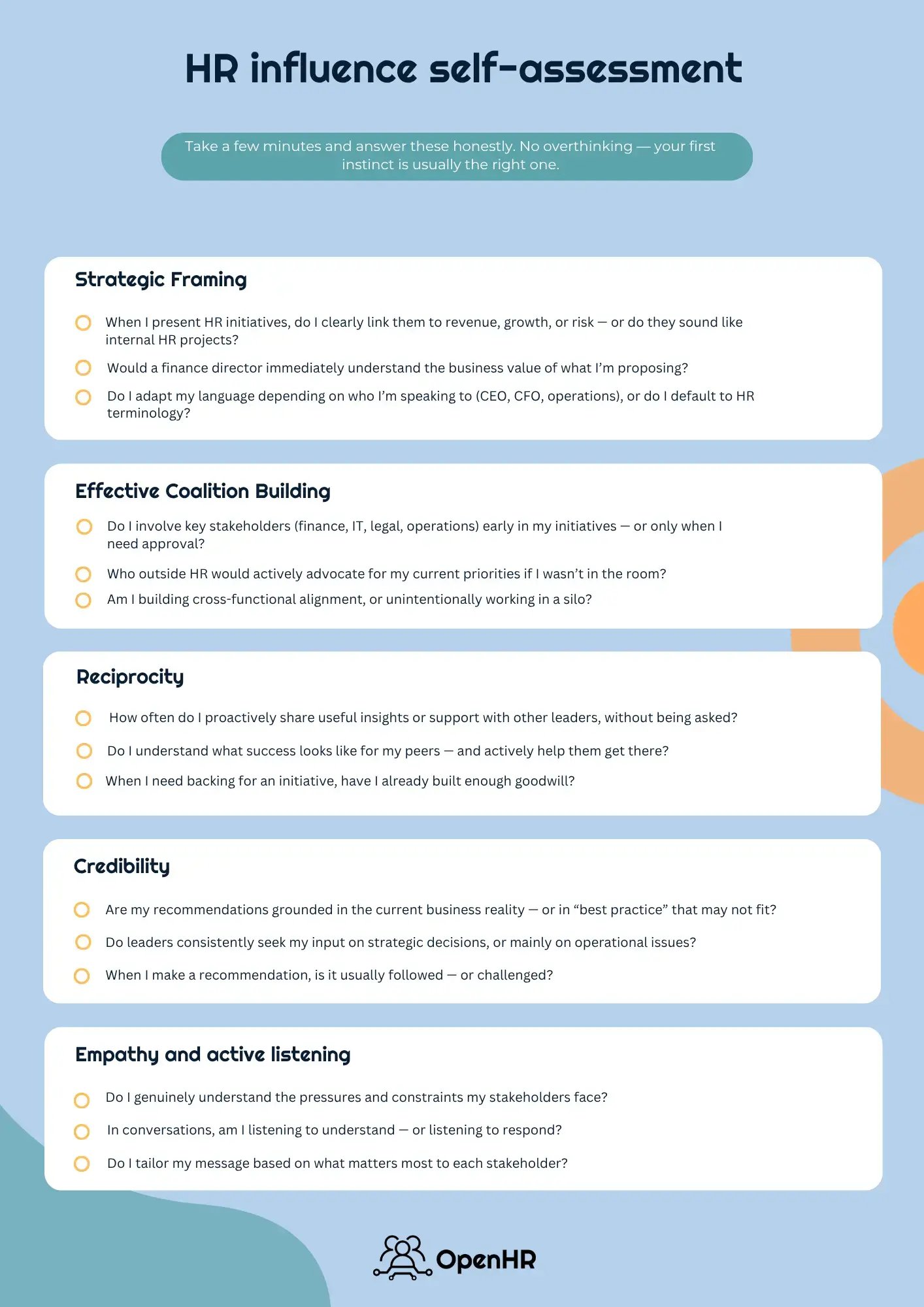
HR influence self-assessment